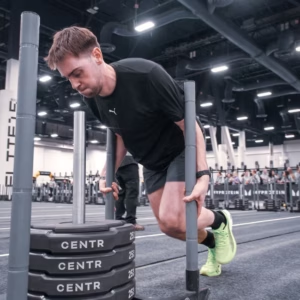





Robert Herjavec, who turns 64 this month, has built a career recognising potential. The technology entrepreneur, investor and familiar face of Shark Tank worldwide has spent decades building businesses and assessing whether other people’s ambitions can become reality.
His career spans founding and selling technology companies, investing in entrepreneurs and serving as a Shark and executive producer on the television series.
When it came to his own fitness, however, he had begun to underestimate just what was possible.
“I had been telling a lie to myself my whole life that I couldn’t get into better shape than I was,” he says in an interview with Men’s Health.
Herjavec already ran regularly. He believed he ate well. He had the discipline to exercise and the means to seek advice. Yet he had accepted that further improvement might be beyond him.
Less than 12 months after beginning work with Chief and his wife and coaching partner, Emilie, his results challenged that belief. According to clinical testing, Herjavec’s biological-age and fitness-age scores had each fallen by more than ten years.
Chief says Herjavec achieved those results without testosterone replacement therapy (TRT) or peptides. His program centred on resistance training, conditioning, changes to his nutrition, and improved sleep and recovery – a detail that often surprises people who see Herjavec after time apart.
“Inevitably, the second or third question is, what peptides are you on?” Herjavec says. “And then I tell people, Nothing!”
Herjavec also kept supplements to a minimum. According to Chief, his only regular supplement was a blend of creatine and essential amino acids (EAAs), chosen with the aim of supporting cognitive health and providing amino acids, the building blocks of muscle, to complement his training and nutrition.
Discussing his broader recommendations for male clients over 40, Chief says: “The only supplements that we promote to our male clients are from Stait for Men. “Personally I suggest the Creatine & EAA mix, and Stait’s natural daily Hormone Support Capsules.”
Herjavec’s age-score reductions were measured against earlier assessments conducted at UCLA (University of California, Los Angeles), a distinction that matters because Herjavec was already accustomed to testing younger than his chronological age.
Chief points out that “When a client has biological and fitness ages greater than their current chronological age, and reduces it dramatically, that’s basically just getting them to where they should be. But when you see these kinds of reductions for someone already scoring younger than they are, that’s impressive.
“When I was 60, I would test at 55,” Herjavec recalls. “When I was 55, I would test at 50.”
Herjavec had come to expect that reassuring gap, even as both numbers moved upwards. After almost a year with the coaching pair, he says, the pattern changed.
“I suddenly tested in my 40s.”
Herjavec remembers the people carrying out the assessment at UCLA being surprised enough to repeat some of the tests.
“In fact, a couple of the tests, they made me do them again, because to them it simply didn’t make sense.”
He also remembers their advice.
“They literally said to me, whatever you’ve done, Do Not Stop!”

Reconsidering the limits
The dramatic reductions in both age scores are the central result of Herjavec’s transformation.
They also raise a question that reaches beyond the numbers: what happens when someone who already considers himself fit becomes willing to learn again?
Herjavec’s early assumptions will sound familiar to many men. He had a routine. He knew the activities he enjoyed. His age and his body seemed to explain why certain improvements remained out of reach.
Eventually, he began to question those explanations.
“Is that true?” he remembers asking himself. “Or is that a lie I’m telling myself because it’s convenient?”
He had already encountered the value of expert guidance elsewhere in his life. When he wanted to improve as a racing driver, he hired a racing coach. He was ready to apply the same reasoning to his fitness.
“If you want to get somewhere, go with someone who’s been there. When I moved to Australia I asked people I trusted, who is the best at working with guys like me. The answer was universal.”
After starting on his journey with his new coaches, Herjavec posted online that … “I want to become the fittest I can be, and so I went out and hired the absolute best transformation coaches, personal fitness guys in the entire world.”
Chief, a specialised Exercise for Longevity Practitioner (and our former Men’s Health Fitness Director), focuses on helping clients build and maintain the strength, mobility and physical capacity to live their best life at any age. That approach matched Herjavec’s ambition to stay energetic and involved in family life. Together, Chief helped him develop his resistance training and conditioning, with Emilie guiding changes to his nutrition and recovery.
Herjavec brought considerable commitment. Coaching helped him understand where to direct it.
Herjavec describes having assessments at UCLA and other executive clinics in North America.
Alongside the reported changes in those assessments, he describes faster times on his daily runs, greater strength, overall better athleticism and improved recovery.
Learning to train again

Running had long been an established part of Herjavec’s day. He enjoyed it and recognised the sense of accomplishment it gave him. Strength training had proved harder to sustain.
Sometimes he lifted with enough intensity to leave himself very sore, then took the soreness as evidence that weights weren’t for him. At other times, lifting simply didn’t seem to offer the same satisfaction as a run. He returned to what he knew.
Looking back, he believes that familiar routine had stopped delivering what he needed.
“Doing the same thing I’ve always done as I got older was actually moving me backwards,” he says.
One of the clearest changes was how he began judging a strength session. Previously, he associated effective training with very heavy weights. Now his attention rests on how well he performs the movement.
“Chief taught me that your form is far more important than the amount of weight you’re lifting.”
He describes seeing someone beside him in the gym lifting more, their body swinging through the effort, and feeling no obligation to compete.
“The thing I learned from Chief is I leave my ego at the door when I go and train,” he tells us.
That shift follows him into conversations with friends. Asked how many pull-ups he can do, he estimates eight to twelve, but wants to establish what everyone means by a pull-up before comparing totals. He has become particular about control and execution.
“What you learn is progress is takes time, and it’s natural that we want to shortcut progress by doing it wrong.”
For a man accustomed to pursuing results, accepting that process has been significant. He still wants to improve. He has developed a clearer standard for deciding whether he is doing so.
The knowledge also travels with him. Herjavec credits his coaches with helping him understand how to keep training when his location or schedule changes. Consistency has become easier because he understands more about his body, and the work itself.
The habits he hadn’t noticed

Nutrition required a similar level of attention.
Herjavec believed he ate well, but working with Emilie made him more conscious of food he consumed almost without registering it. Family meals provided the example he remembers best.
“I was constantly the vacuum cleaner,” he says, describing the habit of finishing what his children left behind.
A few fries remained on a plate. He would pick at them. It had become an automatic part of the day.
“I wasn’t eating because I was hungry.”
Changing that habit meant becoming more deliberate while preserving the family meals he valued. Planning mattered, particularly when the children were on holidays and their routines shifted.
There was an unexpected development, too. Herjavec became more interested in preparing food.
He recalls buying fillets and fresh corn from a farmer and enjoying one of the best meals he could remember. He has made soup. He wants to learn to cook.
For someone who once described himself as having little interest in food, that enthusiasm represents a change of its own. Paying attention has made his meals more enjoyable.
His account gives a domestic dimension to a transformation otherwise expressed in striking numbers. Some of the work happened in the gym. Some happened in recognising the everyday decisions that had previously passed unnoticed.
Progress beyond the assessment

When Herjavec talks about the physical changes, he describes being able to do more.
He says his average running pace per mile is more than two minutes faster than what he would have considered a good mile two or three years earlier. He feels stronger and notices how readily he recovers between short bursts of effort.
He recalls playing three hours of padel with a friend and the friend’s two sons, both in their thirties. When the others were ready to stop, he wondered why.
Though he still gets tired during a demanding point, what he notices is how ready he feels for the next one.
These are personal accounts of his progress, but they help explain why the results have mattered to him. The improvements extend into activities he enjoys and the time he spends with the people that matter to him.
Herjavec describes a benefit in his working life as well. Training with Chief has given him practice at staying focused through discomfort, with the understanding that the immediate strain will pass.
He feels better able to bring that composure into difficult situations.
“There’s a calmness I have now that I wish I had in my 20s and 30s.”
The same man who makes decisions about businesses and investments has found value in practising patience with his own progress. He recognises the temptation to expect an immediate result, and the importance of continuing once an early goal has been reached.
A reason to keep going
For all the discussion of age scores, strength and performance, Herjavec’s motivation returns repeatedly to his children.
He is conscious of being an older father, with a younger wife. He wants them all to know him as active and involved, with energy for the life they share.
“I don’t want my energy to decline as I get older,” he says.
That concern helps explain why his commitment has continued beyond the first visible changes.
“I think if I was doing it just for my ego and looking good with my shirt off, I probably would have stopped at a certain point,” he says. “But that greater purpose has kept me going.”
Herjavec recognises the same need for purpose in business. An early target can be reached and left behind. Continuing through the difficult days requires a reason that survives beyond that first success.
His children supply that reason. They are who he thinks about when he is tired or reluctant to train.
The reduction of more than a decade in both biological age and fitness age, achieved in less than 12 months, remains the defining result of his work with Chief and Em. It has also given Herjavec a reason to reconsider the expectations he once held about the years ahead.
He arrived with habits he trusted and limits he assumed. He now describes a greater capacity to move, recover and participate in his own life.
“I’m a pretty motivated guy, as you know, but even I fell into that trap that I can’t change.”
The work continues. The results have altered his expectations, and his family gives those expectations a purpose. Asked what comes to mind when the effort feels harder, his answer is uncomplicated.
“I always think of my kids.”
Looking to turn back the biological clock? Reach out to Chief and Emilie at TransformationCoach.com