




The Death March
The scene: Beaufort Caravan Park, Victoria. Day 82. 3.30 a.m.
I had not slept. Ten hours in the van with no sleep. My left foot felt like someone had spent the night hammering a nail into the base of it from the inside. At midnight, I woke up needing the bathroom and discovered that I couldn’t stand. So I urinated into an empty Powerade bottle while lying down. I lay there for the next few hours, trying to find a position where the gravity pressure on the broken bone was tolerable. There was no such position. I started to drift off at 2.30 a.m., but the alarm went an hour later. I tried to get up but fell back onto the bed. Tried two more times.
Fell back again and again. On the fourth attempt I made it, just like Lach had back in Western Australia on day nine. The boys helped me out of the van. The caravan park showers were 200 metres away, and it took me over ten minutes to cover that short distance. Each step felt like being crucified on the cross from the bottom up.

In the shower I turned the water as hot as it would go and stood in the steam. On the little stool beside me I had put two beef bars and a packet of ibuprofen. The expiry date had passed but I didn’t check.
I ate the beef bars in the shower, water running over them, because I needed food in my system before the ibuprofen hit. I swallowed the expired tablets, then I stood on the shower floor and stamped both feet down as hard as I could manage, over and over, for ten minutes, trying to drive blood back into the bones of the left foot, trying to create enough sensation to move on.
I trudged back to the van and tried to put on my shoes, a process that took five minutes of screaming because the swelling meant forcing a size ten foot into what felt like a size seven shoe.
We set off at a speed of 4 kilometres per hour. To cover 50 kilometres at that pace consumed most of the waking hours of the day. We had announced to our audience that we would finish on the coming Sunday and had the final day event fully planned, with supporters set up at the finish line. Every day was now becoming mission impossible thanks to a deadline we could not move.
Hope is the fuel when everything else is gone. The ibuprofen was doing nothing for my foot. Our bodies were running on fumes. The thing that remained was the image of the finish line, of Nanny Jan holding the tape, of getting home. Hope was a decision that we made every morning, choosing to believe that what came next was worth the cost.
I walked the entire day without stopping at pit stops, because stopping meant that the swelling surged and standing up again took minutes of agony. I grabbed Gatorades from passing hands and kept moving.
To understand day 82, you need to go back to day 76 when we crossed the Victorian border.
There was an iconic blue sign welcoming us to our home state of Victoria. We smashed it with both hands and screamed. The last one. But when we ran away from the sign, Stef was moving at nine minutes and seven seconds per kilometre. Not a running pace. Barely a walking pace. He had the high-vis jacket clenched in his mouth the entire day to muffle the sounds coming out of him, the same jacket handed to us by two big tradies in the rain on the Nullarbor.

An X-ray of Stef’s broken foot
On day 77, I knew Stef ’s foot was broken. This was later confirmed by an X-ray two days after we finished our run. There was a comminuted fracture in the third metatarsal. Basically, this means the bone has two or more frac-tures. Stef told me his foot was broken, and I couldn’t believe that he had been running on it. I now know how high Stef ’s pain tolerance is. By the end of day 77, Stef ’s foot was so swollen that it looked like one giant toe. There were no individual bones visible. Nobody had seen anything like it.
Stef could barely lift his left foot off the ground. Running requires a moment of flight, however brief, where both feet are in the air. From this day on, Stef couldn’t fly. He could only shuffle, jaw clenched around yellow polyester, at ten minutes per kilometre towards Melbourne. If we stopped, we died. Not the run, but us. Going home now meant going back to no jobs, no purpose, no identity, and failing everyone who had donated and followed and shown up along the road. That was not an option.
Your level of success will eventually catch up to your level of self-development. Develop yourself. There were days when it felt like nothing was changing. Every morning looked the same, every step hurt the same and Melbourne still felt impossibly far away. Looking back, we realised progress had been happening long before we could see it. Life often works the same way. Keep showing up, even when it feels like nothing is changing. One day your circumstances will catch up with the effort you’ve been putting in all along.
However close, we still had work to put in, and the outlook was ominous. Jordy named what was coming ‘The Death March’. Eight days left with over 400 kilometres to run.
That night, five of my best friends arrived as a surprise at the Nhill Caravan Park. They had driven from Melbourne and were going to run with us. Stef told nobody about his foot. The rule established weeks earlier still held: if the pain is under seven out of ten, don’t mention it. But his foot was a nine. He shuffled 52 kilometres with the boys the next day, the longest single day of the entire run, without saying a word about the fracture. He grabbed Gatorade at pit stops without stopping and hid his pain so completely that my friends went home not knowing about the break at all. We found out later that these lads were written off for three weeks after just one day with us, despite running on fresh legs and good sleep and reasonable nutrition.
Stef had done it on a broken foot, caffeine and whatever was left of him by that point, which turned out to be enough.

The Lambros at the finish line
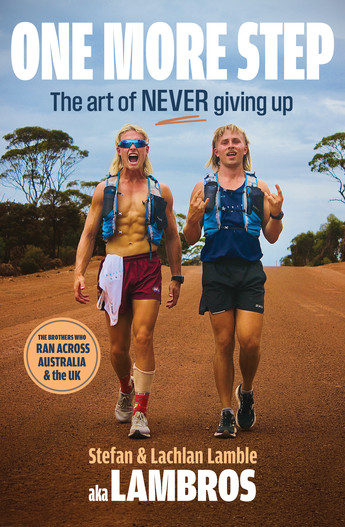
This is an extract from the Lambros’ new book, One More Step: The Art of Never Giving Up, by Stefan & Lachlan Lamble aka Lambros ($34.99; Allen & Unwin), on sale now.
Related:
Meet the Lambros, the Aussie brothers running across the UK to raise money for cancer research